Showing posts with label Main. Show all posts

Thursday, July 31, 2008

Kachnaar ki kali ki sabzi

This is a guest post. This entry has been sent in my my mum and her friends Meera and Sunita. Thank you ladies, you are the sweetest!

Kachnaar ki kali are beautiful yellow blossoms of St. Thomas's tree also known as Bauhinia Tomentosa. This is what it looks like. I believe the leaves and flowers of this plant has medicinal values too. Here the ladies have made a sabzi(sauted preperation) with the buds, looks yummy!

more about kachnaar here

Ingerdients:

1. Kachnar kali (buds) 250 g

2. Onion 1 medium

3. Garlic 2 cloves

4. Ginger ½ inch piece

5. Dhania Powder 1 and ½ tsp

6. Haldi Powder ½ tsp

7. Chilli Powder ¼ rsp

8. Rice Powder 1and ½ tbsp

9. Oil 4 tbsp

10. Garam Masala pinch

11. Salt to taste

12. Few methi (fenugreek) seeds

Method:

o Boil buds for five minutes till tender.

o Grind onion, garlic and ginger to make a paste

o Put oil in karahi , crack mathi seeds and and fry the paste till light brown.

o Add all the dry masala ( dhania, haldi, chilli and salt) till masala leaves oil.

o Add boiled buds , mix in masala and cover for 2 minutes on slow fire.

o Remove the lid and add rice powder and fry for another 5- 10 minutes. Sprinke Garam masala and Garnish with Green Corriander.

o Serve with roti/ paratha.

Sunday, May 11, 2008

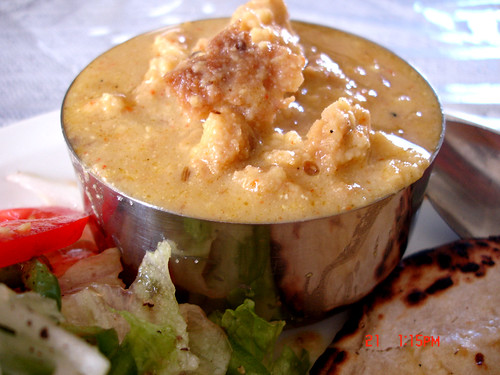
Rajasthani Gatte ki kadi

There is a small village in rajasthan called Nathdwara, its the place Ive been going to since childhood on every trip to India from Africa... the places and darshan of the deities refreshes the soul and also ignites your gastronomic senses. From the prasadam that we get with all the darshan to the street food, it is the best Ive ever had. I consider my Dad a connosieur of taste and when he says that the taste of the rabdi is the most authentic, then there's no argument!

"Set amid idyllic hills, it provides a welcome respite from the searing heat of Rajasthan. The modest sized town is home to one the wealthiest temples in India. The town in it self is famous for it's exuberant festivals, miniature paintings, jewellery and above all, it's sweets. Threat of cholesterol and calories have yet to deter the culinary experts of this town who add sugar and butter to almost all dishes!! Life in the town revolves around the "Haveli" term used for all the temples of the "Pushti Marga". This is one of the most colourful sects within the devotional side of Hinduism. It also happens to be one of the few that do not advocate renunciation for spiritual growth. It is this worldly, practical and realistic view of life that lends itself to the colourfulness of the sect. ": Source

read more about nathadwara here...and here
Just outside the temple is a rabdiwala... that sells rabdi early in the morning in tiny earthenware cups. The taste is soooooo ...um..... I dont have words to describe how delicious it tastes!!! As I go through memory lanes of my childhood, we would then proceed through the small galis and shop for lovely artwork and rajasthani jewellery (little mirror work on almost everything), and then reach a place that serves elaichi doodh and besan papdi... the papdi is a long strip of steamed and fried papdi strips with the usual mustard, hing, corainder tadka with imli chutney, oh yummm. I remember the elaichi doodh to be so fragrant and soothing, God knows what they put in it!!! Right next to this place was all the tangawalas and the next highlight was taking a ride on the tanga (horse drawn traditional carriage) to the outer gali for the best dhokla I've ever had. This dhoklawala keeps his dhokla soaked in water and lots of corainder all the time!! Its the most spongiest khaman dhokla, I have yet to see a dhokla as springy as that one. The prasad we get in the evening finishes you and your day. I remember giant mathris, and ladoos with incredible taste, kadi and khichdi, gadmad ki sabzi...wow... I wanna go back and expirience it all again... This is the nostaligia that the mention of Rajasthan invokes in me. So to celebrate the special RCI: Rajasthan, I made Gatte ki kadi....
Ingredients:

For the gatte:
- 1 cup besan (chickpea flour)
- 1 tsp jeera (cumin seeds)
- 1/2 tsp ajwain (carom seeds)
- salt to taste
- water to make dough

For the kadi:
- 1 cup dahi (yoghurt)
- 3-4 whole dried red chillies
- 4-5 tbsp ghee (more like a dollop)
- 1 tbsp jeera (cumin seeds)
- 1/2 tsp turmeric
- pinch hing (asafoetida)
- salt to taste
- 4-6 cups water

How to make the gatte:

Combine the besan, jeera, ajwain and salt with water to make a firm dough. The dough should not be too soft and not as hard as the dough for mathri....firmer than roti dough. Make cylindrical pipe like shapes of 20cm length and 1.5cm thickness. Drop the cylinders in boiling water and let it boil for 14-15 minutes. Drain and cool. The cylinders will have a 'skin'. Peel the skin with a scrapper like you would scrape carrots. Cut the cylinders into 4cm pieces. Deep fry the pieces (if you want to make it authentic, then it should be fried in ghee as everything in rajasthan is said to be made with ghee!, if you gasped in horror at that statement you can fry them in normal cooking oil). See kailas kitchen on some pictures of the gatte making process.

To make the kadi:

The gravy for this kadi is so simple and its the simplicity of the kadi that highlights the gatte. Heat a large pot and a dollop of ghee on high heat; add the hing, jeera, red chillies in that order while stirring. Add the yoghurt and four cups of water. Add more water if you want a more runny kadi as the gattes will eventually soak up lots of water; you can do that at a later stage too, if you find that the kadi is too thick. Add salt and turmeric and bring to a boil. Reduce the heat to a medium and simmer the kadi for a 10-15minutes. The gattes will soak up more and more water as they sit in the kadi. This kadi can be had with plain rice or tandoori roti.

Ive served it with a tandoori roti and a scrumptious salad... to Spicy Andhra for her lovely RCI:Rajasthan event.

Monday, October 15, 2007

Vrat Kadi for Navratri: carrot kofta in yoghurt gravy

Its navratri time, time to fast, feast and wait for all the rest of the festivals to hit you! Navratri is composed of nine days of celebrating the female energy of our creation, in the most revered form, the Mother Goddess. All throughout India, from state to state, the Goddesses are prayed.

"All Hindus celebrate this festival at the same time in different ways in different parts of India as well as around the world. In the northern part of the country, the first nine days of this festival, called Navaratri, is commonly observed as a time for rigorous fast, followed by celebrations on the tenth day. In western India, throughout the nine days, both men and women participate in a special kind of dance around an object of worship. In the south, Dusshera or the tenth day is celebrated with a lot of fanfare. In the east, people go crazy over Durga Puja, from the seventh till the tenth day of this annual festival. Although, the universal nature of the festival is often found to transcend regional influences and local culture, the Garba Dance of Gujarat, Ramlila of Varanasi, Dusshera of Mysore, and Durga Puja of Bengal need special mention." Source.

From my childhood days, Ive spent these nine days fasting and feasting on yummy fasting food, hearing bhajans glorifying the mother goddess and waiting for my ‘kanjak’ on the 8th day. (In Punjab, on the 8th (ashtami) day, little gifts and a plate of halwa-poori, chole is given to little girls). Now that I’m a big girl :D I make these special dishes at home too and hand out kanjaks to little girls around the neighbourhood and daughters of my friends!

Now onto some yummy fasting food: fasting on navratri days usually, means restricting oneself to only certain things and avoiding grains, dals and most spices and vegetables. Different people fast in different ways so please go ahead and tweak this kadi in anyway to suit you. This kadi may have some ingredients that are not taken for strict fasting, and I will try to offer substitutions.

What you need:

For the koftas:

-2 cups finely grated carrots (can substitute with grated plantains or sweet potato)
-1 cup (approx) potato flour (can use rajgro flour that’s used during fasting)
-1 boiled and mashed potato
-Salt (some people use black/rock salt) to taste
-1/2 tsp chilli powder.
-1 tsp whole black peppercorns
-Oil for deep frying

For the kadi:

-¾ cup potato flour

-1 cup full cream milk (can use water too)
-2 cups yoghurt (preferably sour Indian curd)
-Salt (some people use black/rock salt) to taste
-1 tsp chilli powder

For the tadka:

-2 tbsp ghee
-4-5 whole dried red chillies (broken into pieces)
-2 tsp jeera (cumin seeds)

What you need to:

1. Combine the ingredients for the kofta to make a soft, moist dough, it should not be dry. Make into small balls. Makes about 22. (I made this to take to the temple). Deep fry them in oil (or ghee, if you want). Allow the koftas to cool.

2. Add milk, salt and pepper to taste to the potato flour and combine to make a dosa-(pancake)-batter-like consistency. Keep aside. In another bowl, lightly beat the yoghurt (curds).

3. In a big pot make the tadka: add the ghee and when hot, add the jeera and broken red chilli pieces. When the spices become a shade darker, add the potato flour batter and then add the beaten yoghurt. Bring to the boil.

4. When the kadi is boiling vigourously, turn the gas to a medium-low, and let it simmer until it thickens.

5. When the kadi thickens, switch off the gas and let it cool slightly. Add the koftas and gently stir. Let the kadi sit for some time (maybe 10 minutes) to allow the koftas to soak up the liquid. Serve hot with vrat rice or have as is with jeera potatoes.

This is going to Vee of Past Present and Me for the wonderful event JFI special series: The festive series...

Friday, August 17, 2007

Methi and Leftover dal ki missi poori with aaloo

Ok, I give in. This whole week, I said to myself I wudn't fry, and be on this 'healthy' salad diet. And what do you know? There's an event, more like an invitation to a party to encourage us to fry pooris and to have it with the ever tempting aaloo sabzi...grrrr

So yesterday I said, what the heck...I might as well make it :) which made hubby the happiest person on the planet. Anita, this whole week you are shining on my blog :), you sure are good at tempting others to cook. With blogging about food like this, for sure we will never loose our tyres....

Since its raining poori aalo in the blogosphere and everyone was making pooris with plain aata, I thought I should make my dal methi poori. Using leftover dal? u ask; yup, I say.

I have two aaloo bhaji recipes here, one which I've always had in my parents house with poori, kachori, etc and the second one is a southie version, my mallu friend taught me. Each is in its own league. I made the second one yesterday which was devoured before I could take any pics :S

I usually make these pooris whenever there is any kind of leftover dal, and my hubby always encourages me to make excess dal so that I make his dal pooris!! For the pooris I made yesterday I had lots of dal palak (mung dal split with spinach and onion tomato tadka) left from the previous day. The dal should be a mushy mushy consistency. Offcourse these methi pooris can be made on the tava with lesser oil too, but Anita said F R I E D, so we fried, :p.

Image : The dry ingredients before kneading with the dal
For the methi missi poori you need:
-1 cup aata (any brown bread flour)
-1 cup besan (chana flour)
-2 tbsp dried kasuri methi
-1 tsp dry dhania powder (optional)
-some leftover dal

what to do
1. In a bowl throw in the aata, besan and methi. Optionally add a tsp of dry dhania powder. Use the leftover dal to knead the dough (dont use any water). If you run out of the dal, use milk to combine the rest of the flour. Make a fairly stiff dough. Even if they dont rise while frying, they will be moist because of the besan and dal. No chance of getting any cluries (cardboard like poories)!!

2. Take enough dough to make a 10cm round which is 1/4cm in thickness (it should not be too thin, else you run the danger of them becoming cluries; it should not be too thick, else you run the danger of them not getting cooked through).

3. Deep fry them, in hot oil until they are pink in colour. Alternately toast them on a tava like missi roti, painting with a little bit of oil on both sides.

4. Find any bhaji to eat with and devour quickly. Also you can have them just like that rolled with mango or lemon pickle. Its excellent tiffin and picnic food. (Makes 12 small pooris)

Aaloo bhaji 1 (northie version)- has more gravy
what you need
- 3-4 boiled potatoes finely chopped
- 1 tomato finely chopped
- 1 tsp jeera (cumin seeds)
- 1 tsp methade (whole fenugreek seeds)
- 3 tsp oil (any vegetable oil)
- salt and chilli powder to taste
- 3/4 tsp haldi (tumeric)
- handful of finely chopped green coriander

what you need to do
1. Heat the oil in a deep pan. When hot, throw in the jeera and methade. When they change a few shades darker (which takes a few seconds), put in the tomato and saute briefly. Add three of the chopped boiled potatoes and add 3 cups water.

2. Whilst it starts coming to the boil, mash the one potato that was not added. Add salt, chilli powder, and tumeric. Dont think the tumeric is too much, we need a deep yellow colour. When it comes to a strong boil add the mashed potato and simmer for 10 minutes. Garnish with coriander and serve with poori or kachori.

Aaloo bhaji 2 (southie version) - is a semi dry consistency
what you need
- 3-4 boiled potatoes coarsely chopped
- 1 onion coarsely chopped
- 1 tsp finely chopped ginger
- 4-5 green chillies split
- 1 tsp rai (mustard seeds)
- 1 tsp urad dal
- 3 tsp oil (any vegetable oil)
- salt and chilli powder to taste
- 1/4 tsp haldi (tumeric)
- 4-5 sprigs of mint

what you need to do1.
1. Heat the oil in a deep pan. When hot, throw in the mustard seeds and urad dal. When the mustard seeds starts to splutter(which takes a few seconds) add the urad dal and ginger and green chillies; saute until they change a few shades darker (which again takes a few more seconds) or when you hear people in the adjacent room coughing. Put in the onions and saute for some more time, until the onions become translucent. Add the chopped boiled potatoes and add 1 and a 1/2 cups water.

2. While it starts coming to the boil, add salt, chilli powder, tumeric and mint. Here we need a light yellow colour and I promise you the mint is the king in this dish. When it comes to a strong boil, reduce to a simmer and cook for another 10 minutes. Serve with poori.

Saturday, August 4, 2007

Express Sukhi dal with phulka and salad


How many times do we want a quick meal because we are so hungry, or because we are out of time? A lot of times I have a hungry hubby calling me that he's on his way home and ravenous. Amd most times no take away order satisfies the belly like a yummy homemade meal.

The express event in which we need to cook a full nutritious meal within 30 minutes conceived by mallugirl of Malabar Spices is a superb idea. I told her it would be a great resource; to pool in express ideas that'll come to our rescue when we are in such an edaciously vulnerble state!

I love this sukhi dal, even if its made in 45 minutes too! Its that yummy. You can use urad split as opposed to moong that I've used here. This dal is also used to stuff samosas and its equally yummy with any roti or phulka.

Timing myself and serving a meal for two, here goes:

What I need:
- dough for roti (am not counting dough making for the roti, alhough I know some superwomen who can squeeze that in too!): combine warm water with brown bread flour (atta) to make a soft dough. This dough can be refridgerated for later use too, like i am using dough from the fridge here.
- 2 cups moong split (yellow moong dal without skin - moong dhuli)
- 8-10 shallots (can use 2 large size onions and a tsp of sugar when sauteeing them)
- 2-3 tsp ghee/oil (any vegetable oil) for the tempering
- 2 tsp jeera (cumin seeds)
- 3 tsp ginger powder (saunth)
- 2 tsp dry dhania powder (coriander seeds powder)
- a pinch of garam masala
- a handful of freshly chopped dhania (green coriander leaves)
- 1/2 tsp haldi (tumeric)
- salt to taste
- lemon juice (from about 1 lemon)
- optional salad ingredients (such as a cucumber, half a head of lettuce, a tomato, and a small green pepper)
- green chillies (optional)

What you need to do (timed):

(0 - 5 min)
1. Wash the dal in three rounds of water. Put the dal with double the amount of water (for this recipe 4 cups), haldi and salt on a high flame. Peel the required number of leaves from the lettuce head, wash them under running water and leave them to drip (I hate watery salad leaves). Peel the shallots, and gather your spices.

(5 - 10 mins)
2. Chop the shallots (not too finely, about 3/4cm cubes) and give the dal a stir. On another burner, put a kadai(wok) on medium flame, and put in the ghee, when the ghee becomes hot (takes a few seconds). Add the jeera seeds and saute briefly, when the jeera changes a few shades darker add the ginger powder and shallots and saute.

Chop the green coriander leaves and keep aside. When my chopping board is empty of the onions and the coriander leaves I start chopping whatever I can fathom and combine as a salad from the fridge. Chop an english cucumber into half and then into slices in between stirring the dal and swaying the onions. The dal should be coming to a boil by now.

(10 - 15 mins)
3. After chopping/slicing the cucumber, start chopping the green pepper (keep emptying your chopping board into a bowl). When the dal come to a strong (rolling) boil, cover the pan and reduce the gas to a medium low. Chop a tomato and throw that into the salad bowl tool.

Keep moving the onions, we need to caramalize them, not saute them to a mash. They should retain a crunchyness. Add the dhania powder, and garam masala to the onions and stir. Give the dal a stir after 3-4 minutes.

(15 - 20 mins)
4. Take the onions off from the flame, let cool and put the tava(flat griddle) on the stove. Make enough balls from the dough for the number of phulkas u need. Roll each dough into a 15cm round and put on the tava. When it changes colour (thats maybe 30 sec) turn and cook the other side for about a minute (in between you should be rolling another dough ball). Throw the phulka on an open flame (and simultaneously the next rolled dough circle onto the tava), keep turning the phulka on the open flame until it rises to the fullest. Take it off from the flame (optionally dab the phulka with a tiny bit of ghee) and pile it up in a roti box. Keep the phulka process going and check and stir the dal, if the dal seems too dry, add another 1/2 cup of water. Cover and let it simmer further.

(20 - 25 mins)
5. Keep working on the phulkas. I made 6 phulkas for a hungry husband and a hungry me. If you are done with the phulkas, tear up the salad leaves into bite size. Now if the salad is too naked for you, you might as well dress it the way you want. Sometimes we just sprinkle salt and pepper on it; and other times I shake some salt, black pepper, lime juice and a tsp of olive oil in a small bottle and dribble over it, its your choice really. Stir the dal and check if the dal is cooked (slighltly cool a few granules of the dal and press between two fingers). We want the dal to be cooked thouroughly just before it reaches the state where it can be mashed up, dal al dente?!

(25 - 30 mins)
6. Cook the dal for another couple of minutes if needed. Sprinkle the sauted onions, chopped coriander leaves and lemon juice onto the dal and combine. Serve the dal with a phulka and a big serving of salad into two plates. And then dig in this healthy quick meal offcourse!

Sunday, July 1, 2007

Dahiwala Baingan Bhartha (Smoked aubergines with yoghurt)


I know my hubby was a punjabi in his previous life and I must've been a malayalee. The passion with which he looooves makki ki roti with dal, aalo ka parantha with white butter, any kind of dhaba food, pakoras of any kind is beyond comprehension.

The same way, my folks wonder what happened to their punjabi daughter (me) and my changed taste buds when I go on on about the intoxicating onam sadya I had had, and the appam with stew (gosh I should make this soon), parip payasam, nool puttu, parip vada, thorans of any kind, aviyal and moorkootan.

One such punjabi dish that hubby loves to have with tandoori roti is dahiwalla baingan bhartha. Its a tweak of the usual baingan bhartha that is made with tomato and peas.


What you need:

3-4 large aubergines
1 cup of plain yoghurt
salt and chilli powder to taste

for the tempering:
3-4 tsp of oil
1 tsp mustard seeds
a pinch of hing
2-3 sprigs curry leaves

method:

1. Roast the aubergines directly on the fire until they are completely charred from all sides. Keep the stem away from the flame and use it to turn them as the aubergine roasts. Cool in a plate. (Dont worry, its not going to burn the aubergines, it'll only give them a smoky flavour and cook them through.)


2. Peel the burnt skin and wash each aubergine gently under running water. Chop of the stem and mash the flesh of the aubergines. They can also be run in the processor.


3. In a bowl whisk the yoghurt. Add the mashed smoked aubergine flesh. Add salt and chilli powder to taste.

4. For the tempering. Heat the oil on medium high flame. When the oil is hot, add the mustard seeds, hing nd curry leaves. When mustard seeds start to splutter, add to the yogurt bowl and fold everything togethor. Serve with tandoori roti or rice. Serves 4.


I am sending it over to Sangeeta of Ghar ka khaana, as a second dish for JFI. JFI is conceived by Indira of mahanandi.


I am also sending it to the RCI-regional cuisines (Punjab) event where different regional cuisines of india are celebrated every month. It was conceived by Lakshmi of Veggie Cuisine and hosted this month by lovely Richa of As Dear As Salt.

Saturday, June 30, 2007

Baingan aur Paneer ki sabzi (Aubergine with Paneer)

I am chugging along in recipe and cooking-land in my skoro-skoro (local african word for an old about-to-break-down-any-minute car!) when a flash hits me in the eye, and I adjust my rear-view mirror to see a sparkling, fast moving object approaching from behind. "It's a beamer", I say to myself, as it approaches and wooshes by, overtaking me and dissapearing upfront.

Heee heee, that was the best way I could think of telling how Adt (a dear dear friend of mine) has evolved as a foodie. She's become an amazing cook, and has an amazing collection of recipe books and I am becoming a big big fan of her recipes!! This time, she's especially cooked for my blog a baingan dish for the JFI event. Baingan and paneer, a very unusual combination and totally yummy too. She adapted the recipe from the book, The Higher Taste.

what you need

- 1 large eggplant (cut in 2cm cubes)
- 200gms paneer (also cut into 2 cm cubes)
- ghee for deep frying (can use oil too)
- 1/2 tsp fresh minced ginger
- 1/2 tsp fresh minced green chilli
- 3/4 cup tomato puree
- 1 1/2 tsp black mustard seeds
- 1/4 tsp turmeric- pinch of hing (asafoetida)
- 1 tsp ground coriander
- 1/2 tsp garam masala
- 1 tsp brown sugar
- salt to taste

1. In a wok/kadai, heat the ghee/oil to medium hot temperature. Deep fry first all the paneer, then the aubergine. Drain paneer and aubergine cubes on kitchen paper. Save the rest of the ghee for future use.

2. In a large frying pan, heat about 3-4 tbsp of ghee over high heat for 30 seconds (the ghee kept after frying can be used here). Stir in mustard seeds, chilli, ginger and hing. When mustard seeds start popping and people in the next room are coughing from the chillies :) add the tomato puree. Cook for another couple of minutes and add the rest of the spices. Stir to saute everything togethor.

3. Now add the aubergine and fold everything togethor. Simmer uncovered for 8 minutes. Lastly add paneer cubes and fold gently, cover and cook for another 2 minutes. Serve hot with roti or rice. Serves 4

Thanks Adt for this great recipe! I am sending it over to Sangeeta of Ghar ka khaana, as she is hosting this month's JFI and she has chosen aubergine as the ingredient of the month. JFI - is where we celebrate ingredients one by one and is conceived by Indira of mahanandi.

I feel the combination of aubergine and paneer is unique and punjabi enough to send to the RCI-regional cuisines (Punjab) event where different regional cuisines of india are celebrated every month. It was conceived by Lakshmi of Veggie Cuisine and hosted this month by lovely Richa of As Dear As Salt.

Tuesday, April 24, 2007

Mooli patte ki bhurji


This is a typical punjabi dish and the burji leaves a unique bitterness in the mouth. Its typical of a mooli after taste and its really an acquired taste that comes after trying it several times. The first time I enjoyed it was when it was served with makki ki roti that was stuffed with grated white icicle mooli with a blob of white homemade butter and a huge glass of salt lassi at home by my mom. I closed my eyes and was instantly transported to a small farm settlement in punjab.

What you need

• Leaves of 6-8 radishes (preferrable white)
• 2 tbs mustard oil
• 1 tsp jeera (cumin) seeds
• 1 tsp ajwain (carum) seeds
• A pinch of hing (asafoetida)
• Salt and chilli powder to taste
• 1 tsp. amchoor or dry mango powder

Wash the leaves thouroughly, drain and chop finelly.
In a kadai (wok), heat the mustard oil and add the jeera, ajwain and hing.

When the seeds are slightly browned and leave an aroma, add the chopped leaves and saute.
The leaves will considerably reduce in qauntity as you cook.

When they are cooked, add salt and chilli powder to taste and amchoor powder.

Serve with raita and a hot phulka. This is my contribution to JFI: Green leafy vegetables by indira of mahanandi.

Sunday, April 1, 2007

Creamy Stuffed Tomatoes

Tomatoes.. I gotta have a bunch in my refrigerator no matter what. Plus they act as a contingency for other cooking plans and recipe disasters. In fact I always find my family members wondering why they appear in every dish I make. Heck, I could throw them into my green salad, who cares if its not green anymore. Contingency because, when I’m in one of those what-do-I-make confusion states or when I’m just cooking for myself, I settle down for a plain good old tomato and black pepper sandwich. Nothing beats that!

So when JFI for April was tomatoes hosted by RP of My Workshop, I jumped up and was like… tomato sandwich? Nah…..I decided on Creamy Stuffed Tomatoes because its so different and my beloved tomato stands out in the sauce like a lovely setting sun in the sky. My, am I getting poetic today or what? I swear it the tomato effect!!!

This recipe is truly a fusion recipe and a first for my blog! Really, my mum takes all the credit for this lick-your-fingers invention. She intended to make her stuffed green peppers and because I had accidentally chopped up her small hand picked dainty peppers in my salad, she decided to take revenge on my stash of tomatoes. The sauce came along with some further tweaks to the recipe and we sat down licking our fingers and laughing on our little veggie war!!!

Ingredients

10-12 medium sized tomatoes cored
Note: Tomatoes that are called ‘Globe’ type are medium-sized, firm, juicy, and like ‘beefsteak’ variety are good raw or cooked. We need tender ones for this recipe and a slight pogginess in the tomatoes disqualifies them from this dish.


Find single serving sized tomatoes to use since we want to stuff them and serve them whole. To core a tomato, use the tip of a sharp knife or peeler to make a shallow cut all around the stem end, and then pop out the core. Scoop out the seeds and the pulp with a grapefruit spoon.

Filling:
2 medium sized potatoes boiled and mashed
75g khoya/paneer
Salt to taste
½ tsp Chilli powder

Sauce:
2-3 tblsp ghee/oil
1 tsp jeera
1 cup (250ml) white sauce or roux
1 large onion finely chopped
100ml tomato puree
Salt to taste
Chilli powder
Pinch of turmeric (to give it a creamish color)
½ tsp dhania powder


1. Combine well the ingredients for the filling. Fill into the deseeded and cored tomatoes. The paneer/khoya can really be excluded if desired, but I feel they add a softness to the filling mixture.

2. Saute the jeera and onions in the ghee until the onions are golden. Add the tomato puree and all the spices except the roux and sauté for a further few minutes. Add the roux when the onions and puree are well cooked with the spices.

Note: To avoid the roux being lumpy, when combining with the milk, it is important that the milk be added very hot and in small quantities to the roux while stirring, to ensure proper mixing.

3. Arrange the stuffed tomatoes in a baking tray. Preferably they should be served in the same casserole/tray. Pour over the creamy sauce and bake in a preheated oven at 180 degrees C for 15-20 minutes to allow the tomatoes to absorb all the moisture.

4. Serve piping hot with Naan or a plain parantha. Its great with a plain phulka too!!