 There is a small village in rajasthan called Nathdwara, its the place Ive been going to since childhood on every trip to India from Africa... the places and darshan of the deities refreshes the soul and also ignites your gastronomic senses. From the prasadam that we get with all the darshan to the street food, it is the best Ive ever had. I consider my Dad a connosieur of taste and when he says that the taste of the rabdi is the most authentic, then there's no argument!
"Set amid idyllic hills, it provides a welcome respite from the searing heat of Rajasthan. The modest sized town is home to one the wealthiest temples in India. The town in it self is famous for it's exuberant festivals, miniature paintings, jewellery and above all, it's sweets. Threat of cholesterol and calories have yet to deter the culinary experts of this town who add sugar and butter to almost all dishes!! Life in the town revolves around the "Haveli" term used for all the temples of the "Pushti Marga". This is one of the most colourful sects within the devotional side of Hinduism. It also happens to be one of the few that do not advocate renunciation for spiritual growth. It is this worldly, practical and realistic view of life that lends itself to the colourfulness of the sect. ": Source
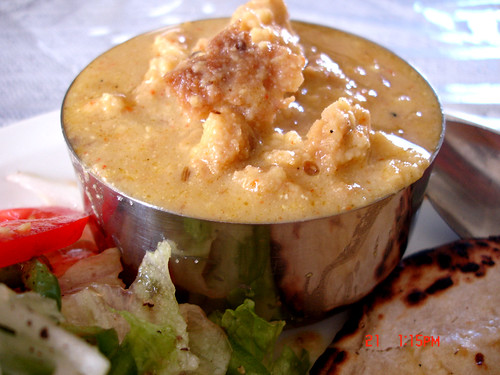
 Just outside the temple is a rabdiwala... that sells rabdi early in the morning in tiny earthenware cups. The taste is soooooo ...um..... I dont have words to describe how delicious it tastes!!! As I go through memory lanes of my childhood, we would then proceed through the small galis and shop for lovely artwork and rajasthani jewellery (little mirror work on almost everything), and then reach a place that serves elaichi doodh and besan papdi... the papdi is a long strip of steamed and fried papdi strips with the usual mustard, hing, corainder tadka with imli chutney, oh yummm. I remember the elaichi doodh to be so fragrant and soothing, God knows what they put in it!!! Right next to this place was all the tangawalas and the next highlight was taking a ride on the tanga (horse drawn traditional carriage) to the outer gali for the best dhokla I've ever had. This dhoklawala keeps his dhokla soaked in water and lots of corainder all the time!! Its the most spongiest khaman dhokla, I have yet to see a dhokla as springy as that one. The prasad we get in the evening finishes you and your day. I remember giant mathris, and ladoos with incredible taste, kadi and khichdi, gadmad ki sabzi...wow... I wanna go back and expirience it all again... This is the nostaligia that the mention of Rajasthan invokes in me. So to celebrate the special RCI: Rajasthan, I made Gatte ki kadi....
Ingredients:
For the gatte:
- 1 cup besan (chickpea flour)
- 1 tsp jeera (cumin seeds)
- 1/2 tsp ajwain (carom seeds)
- salt to taste
- water to make dough
For the kadi:
- 1 cup dahi (yoghurt)
- 3-4 whole dried red chillies
- 4-5 tbsp ghee (more like a dollop)
- 1 tbsp jeera (cumin seeds)
- 1/2 tsp turmeric
- pinch hing (asafoetida)
- salt to taste
- 4-6 cups water
How to make the gatte:
Combine the besan, jeera, ajwain and salt with water to make a firm dough. The dough should not be too soft and not as hard as the dough for mathri....firmer than roti dough. Make cylindrical pipe like shapes of 20cm length and 1.5cm thickness. Drop the cylinders in boiling water and let it boil for 14-15 minutes. Drain and cool. The cylinders will have a 'skin'. Peel the skin with a scrapper like you would scrape carrots. Cut the cylinders into 4cm pieces. Deep fry the pieces (if you want to make it authentic, then it should be fried in ghee as everything in rajasthan is said to be made with ghee!, if you gasped in horror at that statement you can fry them in normal cooking oil). See kailas kitchen on some pictures of the gatte making process.
To make the kadi:
The gravy for this kadi is so simple and its the simplicity of the kadi that highlights the gatte. Heat a large pot and a dollop of ghee on high heat; add the hing, jeera, red chillies in that order while stirring. Add the yoghurt and four cups of water. Add more water if you want a more runny kadi as the gattes will eventually soak up lots of water; you can do that at a later stage too, if you find that the kadi is too thick. Add salt and turmeric and bring to a boil. Reduce the heat to a medium and simmer the kadi for a 10-15minutes. The gattes will soak up more and more water as they sit in the kadi. This kadi can be had with plain rice or tandoori roti.
Ive served it with a tandoori roti and a scrumptious salad... to Spicy Andhra for her lovely RCI:Rajasthan event.


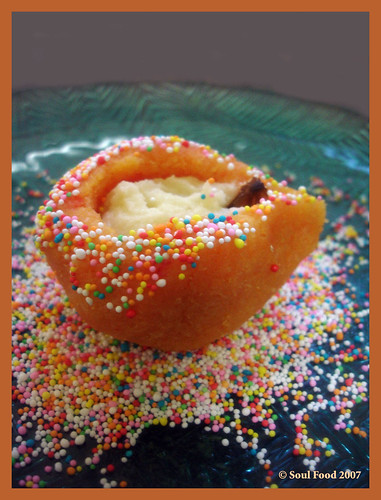
 Diwali is the festival of lights, the celebration of good over evil…light over darkness. Deepavali as it is also called ....means a row of lamps. These lamps are usually made with clay and some women at home make them with ‘aata’ or roti dough.
  When I saw the recipe for these edible coconut diyas, I fell in love with them and promised to make them on diwali….here is the
  So here's wishing all my readers all the happiness in the world.... my advise is ....make lots of sweets, share them with all your family and friends, eat them too and have a joyous time!

 Join the fight against global poverty…. Help feed children one by one…
 What you need to do:
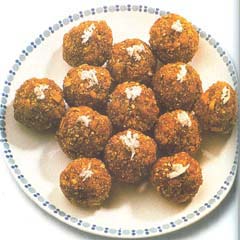
 Verdict: These ladoos look and taste exactly like besan (gram flour) laddoos in texture and 90% in taste, so they are great for when fasting from grains. You just get a peanutty taste instead. Also, there is no ‘extra’ ghee I added this time and they tasted great; the only fat comes from the peanut butter. Plus, I looooved making them because of how easy they were to make. They are really good for kids to make too.
 Now for my first meme that
  Navratri is composed of nine days of celebrating the female energy of our creation, in the most revered form, the Mother Goddess. All throughout India, from state to state, the Goddesses are prayed.
 From my childhood days, Ive spent these nine days fasting and feasting on yummy fasting food, hearing bhajans glorifying the mother goddess and waiting for my ‘kanjak’ on the 8th day. (In Punjab, on the 8th (ashtami) day, little gifts and a plate of halwa-poori, chole is given to little girls). Now that I’m a big girl :D I make these special dishes at home too and hand out kanjaks to little girls around the neighbourhood and daughters of my friends!
 What you need:


 Guruwayoorappan pic