Showing posts with label Punjabi. Show all posts

Tuesday, October 30, 2007

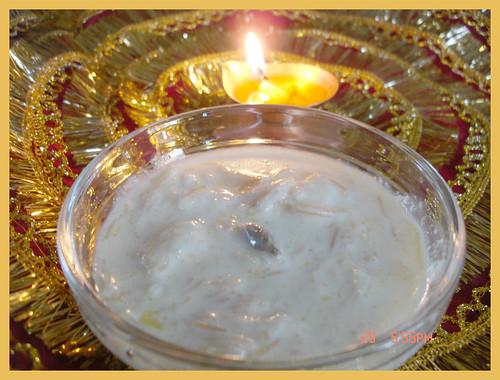
Karva chauth di sargi: Early morning vermicelli pudding

I love fasting on karva chauth despite it being a grueling day of controlling your hunger and thirst, and not because it’s the most fanciest custom that bollywood has to show in their movies nowadays. But fasting like this is when one gets to really appreciate the food we eat and the water we drink daily.

Mostly I feel more thirsty than hungry. But somehow it feels good to fast on the day. Its not just 'fast for your husband's long life' as is mostly portrayed, its also about celebrating your wedded life and marriage.

The day started for me at 3:30am, when I got up to eat my sargi and to drink all the water I could before sunrise. ‘Sargi’ is just the (punjabi) name given to the delicious vermicelli kheer (see recipe below) eaten in the morning.

According to traditional custom, a married woman takes the 'sargi', which is prepared specially for the ocassion by the mother-in-law, and leaves on the previous day to go to her mother’s house. In the wee hours of the morning she eats it with her mother and other aunts that have gathered there. The fast begins at twilight, and women fast from food and water.

When the day starts, the women folk spend decorating themselves with henna and getting dressed up in their wedding apparels, and pretty much look like brides. In today’s times they go shopping, they especially buy decorated bangles and sometimes spend the afternoon at the movies!
Around late afternoon, ranging between 3pm to 6pm (depends on the individual family custom), the daughter-in-law arrives with her mother and her aunts at her in-laws place. Here all the ladies, including that of the neighbourhood gather to perform the ‘poiya mansna’ ceremony. They get into a circle and rotate their pooja thalis whilst singing traditional songs.

Ive always heard the one that Ive shown below, “kudiye karwada....”. Here in Africa, we gather mostly at the local temple hall and do this ceremony. Then one of the elder lady tells us the ‘katha’, the story behind the fast. The hardcore ‘pindi’ punjabi (village accent) becomes a foreign language to me and I’m lost after a few lines into the story!

I just enjoy the whole ceremony of seeing so many women all dressed up. Its like seeing all your friends, aunts, and all women as brides all on the same day! We admire each other’s jewellery, mehndi and wedding gowns etc. :D

A lot of woman take their first sip of water after this ceremony, and have some form of liquid to relieve themselves. They have food only after the moon comes out. Some (really dedicated wives) wait with thirsty throats up until the time the moon comes out.

I had a big glass of water at 4:30 pm and then another glass of juice. From then the wait starts…for the moon to come out. In India, I have heard from my mum that the moon comes out around 8:00pm. Then all the women rush outside and offer obeisances to the moon and see the moon through a seive (I have no idea, why all this is done so). Thereafter they break their fasts.

And because some of us are in the southern hemisphere… we waited till 10:30pm and there was no sign of the moon… After another gruelling, half an hour…the moon was sighted at 11:00pm and we finally broke our fasts and had food. By then I wasn’t even hungry, but nevertheless ate to replenish the energy I had lost! My malayalee husband still doesn’t get why I need to do all this… I know I do it for the fun of it!
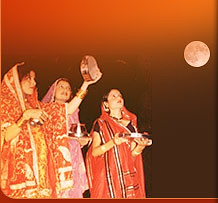
"Karva Chauth Day falls on the 4th day of the Kartik month every year. On this day it is customary for the wife to fast the whole day. She does not drink water either. She paints her hands and feet with henna, dresses generally in red apparel ...

On Karva Chauth day, which is observed in North India, tens of millions of women keep a fast, .... Only after seeing the moon do the women break their day-long fast in the evening/night. Normally women go out of their houses and on their roof tops to see if the moon is up yet.

Here is the song sung by punjabi women, while they exchange thalis seven times.

Veero Kudiye Karwada...., Sarv Suhagan Karwada...,
Aye Katti Naya Teri Naa, Kumbh Chrakhra Feri Naa,
Aar Pair payeen Naa, Ruthda maniyen Naa, Suthra Jagayeen Naa,
Ve Veero Kuriye Karwara,Ve Sarv Suhagan Karwara....... "

picture and text:http://www.karwachauth.com

Karva chauth ki sargi

What you need:

- 250 gm wheat vermicelli
- 50 gm ghee (can completely zero the ghee, if you want to make it fat free)
- 1 Lt full cream milk (can easily use 2% reduced or even skim milk to make it ‘lighter’)
- 200 gms sugar (again, this amount gives the kheer a mild sweetness, up or own the amount to suit your palate). Here sugar can also be substituted for brown sugar or jaggery for more flavour.
- A few pods whole elaichi
- Saffron strands
- Chopped nuts of your choice ( I did not put any in this version)

What you need to do:

1.) In a large pot roast the vermicelli in the ghee. The vermicelli can be dry roasted too (without any ghee for a low fat version). Stir frequently to allow equal roasting.

2.) Add the milk and elaichi pods and bring to the boil. When boiling, reduce gas to a simmer and cook for a further 10-12 minutes. The vermicelli will swell in size and soak up the milk.

3.) Switch off the gas and decorate with saffron and nuts. The kheer (pudding) can be had warm and or can be cooled down and refridgerated and served chilled.

We (mum and I) had it cold in the morning, drank lotsa water and went back to sleep!
This is going to Vee of Past Present and Me for the wonderful event JFI special series: The festive series...

Friday, August 17, 2007

Methi and Leftover dal ki missi poori with aaloo

Ok, I give in. This whole week, I said to myself I wudn't fry, and be on this 'healthy' salad diet. And what do you know? There's an event, more like an invitation to a party to encourage us to fry pooris and to have it with the ever tempting aaloo sabzi...grrrr

So yesterday I said, what the heck...I might as well make it :) which made hubby the happiest person on the planet. Anita, this whole week you are shining on my blog :), you sure are good at tempting others to cook. With blogging about food like this, for sure we will never loose our tyres....

Since its raining poori aalo in the blogosphere and everyone was making pooris with plain aata, I thought I should make my dal methi poori. Using leftover dal? u ask; yup, I say.

I have two aaloo bhaji recipes here, one which I've always had in my parents house with poori, kachori, etc and the second one is a southie version, my mallu friend taught me. Each is in its own league. I made the second one yesterday which was devoured before I could take any pics :S

I usually make these pooris whenever there is any kind of leftover dal, and my hubby always encourages me to make excess dal so that I make his dal pooris!! For the pooris I made yesterday I had lots of dal palak (mung dal split with spinach and onion tomato tadka) left from the previous day. The dal should be a mushy mushy consistency. Offcourse these methi pooris can be made on the tava with lesser oil too, but Anita said F R I E D, so we fried, :p.

Image : The dry ingredients before kneading with the dal
For the methi missi poori you need:
-1 cup aata (any brown bread flour)
-1 cup besan (chana flour)
-2 tbsp dried kasuri methi
-1 tsp dry dhania powder (optional)
-some leftover dal

what to do
1. In a bowl throw in the aata, besan and methi. Optionally add a tsp of dry dhania powder. Use the leftover dal to knead the dough (dont use any water). If you run out of the dal, use milk to combine the rest of the flour. Make a fairly stiff dough. Even if they dont rise while frying, they will be moist because of the besan and dal. No chance of getting any cluries (cardboard like poories)!!

2. Take enough dough to make a 10cm round which is 1/4cm in thickness (it should not be too thin, else you run the danger of them becoming cluries; it should not be too thick, else you run the danger of them not getting cooked through).

3. Deep fry them, in hot oil until they are pink in colour. Alternately toast them on a tava like missi roti, painting with a little bit of oil on both sides.

4. Find any bhaji to eat with and devour quickly. Also you can have them just like that rolled with mango or lemon pickle. Its excellent tiffin and picnic food. (Makes 12 small pooris)

Aaloo bhaji 1 (northie version)- has more gravy
what you need
- 3-4 boiled potatoes finely chopped
- 1 tomato finely chopped
- 1 tsp jeera (cumin seeds)
- 1 tsp methade (whole fenugreek seeds)
- 3 tsp oil (any vegetable oil)
- salt and chilli powder to taste
- 3/4 tsp haldi (tumeric)
- handful of finely chopped green coriander

what you need to do
1. Heat the oil in a deep pan. When hot, throw in the jeera and methade. When they change a few shades darker (which takes a few seconds), put in the tomato and saute briefly. Add three of the chopped boiled potatoes and add 3 cups water.

2. Whilst it starts coming to the boil, mash the one potato that was not added. Add salt, chilli powder, and tumeric. Dont think the tumeric is too much, we need a deep yellow colour. When it comes to a strong boil add the mashed potato and simmer for 10 minutes. Garnish with coriander and serve with poori or kachori.

Aaloo bhaji 2 (southie version) - is a semi dry consistency
what you need
- 3-4 boiled potatoes coarsely chopped
- 1 onion coarsely chopped
- 1 tsp finely chopped ginger
- 4-5 green chillies split
- 1 tsp rai (mustard seeds)
- 1 tsp urad dal
- 3 tsp oil (any vegetable oil)
- salt and chilli powder to taste
- 1/4 tsp haldi (tumeric)
- 4-5 sprigs of mint

what you need to do1.
1. Heat the oil in a deep pan. When hot, throw in the mustard seeds and urad dal. When the mustard seeds starts to splutter(which takes a few seconds) add the urad dal and ginger and green chillies; saute until they change a few shades darker (which again takes a few more seconds) or when you hear people in the adjacent room coughing. Put in the onions and saute for some more time, until the onions become translucent. Add the chopped boiled potatoes and add 1 and a 1/2 cups water.

2. While it starts coming to the boil, add salt, chilli powder, tumeric and mint. Here we need a light yellow colour and I promise you the mint is the king in this dish. When it comes to a strong boil, reduce to a simmer and cook for another 10 minutes. Serve with poori.

Tuesday, July 24, 2007

Gudpara


Using Gud (Jaggery) instead of regular sugar for the syrup in this recipe takes these lovely paras to another level. This recipe is from one of my fav bhabhi, whose an ace gudpara maker. These can be stored in an airtight container for a month or two and is yummy in the winter months. The saunf also gives them a lovely flavour. I usually pop a couple in my mouth after lunch, which satisfies my sweet tooth and the saunf leaves a great taste in the mouth till the evening... this goes amazing with a hot cup of tea too... pure winter indulgence at its best!!

what you need:
- 500gms maida (all purpose flour)
- 1/3 cup (150ml) ghee/oil
- water to knead the dough
- oil for deep frying

for the syrup
- 250gms gud (jaggery)
- 1 cup water
- 2 tbsp saunf (fennel seeds)
- 1 tsp elaichi powder

1. Combine the ghee into the flour to resemble dry breadcrumbs. Add little water to get a fairly hard dough (not too hard). Knead thoroughly to make the dough smooth.

2. Divide the dough into two. With the first half, roll it out to about 1/2 cm thickness. Using a knife cut out strips of size (1cm X 3-4cm). Deep fry the strips and and drain on kitchen paper. Repeat with the second half of the dough.

3. Combine the gud, water, saunf and elaichi to make a thick syrup. Boil the syrup until it reaches 2 string consistency (Cool a drop of syrup on a plate and stretch between two fingers to see approximately two strings). Basically it should be thick and should be solifying at the edges.

4. Quickly add the paras (the strips) into the syrup to coat them evenly and spread them onto a tray to solidify. When cool, store in an airtight container. Eat whenever you like :), makes about a kilo of gudpara.


Another entry for the RCI-punjab to Richa of As dear as Salt, conceived by Lakshmik of Veggie Cuisine.

Tuesday, July 17, 2007

How to make good chunky paneer at home

I love paneer (fresh cottage cheese) with a passion, and if it was possible I would use it in every dish. Bechara (Poor) hubby hardly tolerates it in the usual dishes. Once when we were on transit at the Dubai International airport, I ordered a paneer masala dosa, hubby was so disgusted at me for ruining a dosai by asking the waiter to put paneer masala in it.

Apart from my fusion uses my fav paneer dishes are:
- shahi paneer and all the millions of its variations
- paneer tikka
- paneer pakoda (my all time favourite - sigh)
- paneer parantha
- paneer pulao
- palak paneer
- khoya muttar paneer

I hope to blog all these classic recipes above some time in the future and not forgetting some of my typical fusion paneer bites too:

- paneer masala dosa - (offcourse as mentioned above) make masala for dosa filling and replace potato with paneer.
- kanchipuram idli - sandwich kashewnuts and small paneer cubes in the idli as you fill the idli moulds before steaming.
- have appam with paneer 'stew' - heee, i love this one
- slice a khaman dhokla piece and sandwich a paneer cube in between.
- paneer samosa....yum
- put a toothpick into a sweet (see tweak additions below) paneer piece, drape melted chocolate, and cool in the fridge... when set, its ready to eat....aah its sinfuly heavenly.

Then there is rasgulla and rasmalai made from chenna (unlike paneer which is pressed-milk cheese, chenna is drip hung for a couple of hours). Also I love to have chennamurgi (this is sweet and has nothing to do with any murgi and I have no idea why its called this) whenever I travel to Delhi. I dont know how its made, why that nomenclature and haven't seen a recipe for it yet. Maybe another delhite would know, Anita, have u had it in Delhi, maybe post the recipe :)?

I thought instead of making a paneer dish for RCI, i should rather post a how-to-make paneer at home recipe, since one paneer preparation from the list above for RCI-punjab doesnt give paneer full justification ;). There's nothing like homemade paneer and its so easy to make.

My dad is a pro paneer maker, the paneer expert at home and he says the amount of paneer yielded depends on the quality and freshness of the milk. For homemade paneer he usually travels to a village dairy about 20kms away to purchase fresh milk that they had been extracted that very day. The milk is bought in bulk to make yoghurt, lotsa different types of paneer. The paneer can be easily frozen, kacha or fried.

Here I am displaying how to make simple paneer that can be used in usual savoury curries. I use vinegar to tear out the protein as opposed to lemon juice, because I feel it gives softer paneer than with lemon juice. The salt and sugar gives the paneer a tenderness and is somehow more 'juicy' in the curries.

(To yield approx. 225-250 gms paneer)
1L fresh full-fat milk
1 tbsp sugar
1 tbsp salt
100ml-150ml white vinegar

Some additions that can be added to the milk in place of salt and sugar and the corresponding paneer types that are yielded are (for 1L milk):

- 2 tbsp (or more if u want) sugar for sweeter paneer (eg for my choc-coated bite memtioned above)
- handful of finely chopped coriander leaves (for hara (green) paneer)
- 4-5 tbsp jeera (cumin) seeds (for jeera paneer)
- 4-5 tbsp finely chopped garlic or garlic paste (for garlic paneer)
- fried/roasted paneer for various recipes
- the crumbs can be used in bhurji recipes

Enough yapyap and onto the procedure.

Here I am boiling 15 L of milk, which gave us 3.65kilos of paneer

1. Pour the milk in a heavy bottom pot and bring to the boil on high flame. Avoid stirring too much.


When the milk starts rising immediately reduce the gas to low to bring the milk to a simmer. Pour the vinegar and switch off the gas. This will coagulate - start tearing the milk.


2. Now stir to help the vinegar act more evenly. The water left from the milk (the whey) should go from cream yellow to yellow green.


If the whey is still not greeny enough (like in picture above) it means there is still some more protein left in the milk, add 50ml more vinegar and stir. Let the cheese and whey cool a little.

3. When the cheese whey mixture has cooled a bit (the pot is not burning hot but more than warm) drain it through a sieve lined with a double cheesecloth or thin cotton. Collect the whey, and keep it to add to stews or make dough for roti or parantha with it. Collect the cloth that holds the cheese togethor, wrap it securely and place on a flat surface like a large chopping board. Place it where the cottage cheese can be pressed and the whey left in the cheese can keep dripping - like the area near the sink (where we keep dishes to drip after washing them). Flatten the cheese within the cloth into a squarish shape to the thickness desired (preferrably 1.5cm). Some people make it thinner though. Place another wooden plank or chopping board on top. Add a heavy weight on top of this, like a big pot full of water. Leave it overnight.

Dad chopping the paneer into perfect cubes4. The next morning, remove the 'weight', unwrap the paneer, cut into desired shapes, pack them in separate ziplock bags, freeze some, use some, and pop a couple in your mouth :)

They can be fried and frozen too. Chakde phatte and Enjoy!!!

I am sending this as a third entry to Richa of As Dear As Salt for the RCI Punjab for this lovely event, which has been conceived by LakshmiK of VeggieCuisine.

Sunday, July 1, 2007

Dahiwala Baingan Bhartha (Smoked aubergines with yoghurt)


I know my hubby was a punjabi in his previous life and I must've been a malayalee. The passion with which he looooves makki ki roti with dal, aalo ka parantha with white butter, any kind of dhaba food, pakoras of any kind is beyond comprehension.

The same way, my folks wonder what happened to their punjabi daughter (me) and my changed taste buds when I go on on about the intoxicating onam sadya I had had, and the appam with stew (gosh I should make this soon), parip payasam, nool puttu, parip vada, thorans of any kind, aviyal and moorkootan.

One such punjabi dish that hubby loves to have with tandoori roti is dahiwalla baingan bhartha. Its a tweak of the usual baingan bhartha that is made with tomato and peas.


What you need:

3-4 large aubergines
1 cup of plain yoghurt
salt and chilli powder to taste

for the tempering:
3-4 tsp of oil
1 tsp mustard seeds
a pinch of hing
2-3 sprigs curry leaves

method:

1. Roast the aubergines directly on the fire until they are completely charred from all sides. Keep the stem away from the flame and use it to turn them as the aubergine roasts. Cool in a plate. (Dont worry, its not going to burn the aubergines, it'll only give them a smoky flavour and cook them through.)


2. Peel the burnt skin and wash each aubergine gently under running water. Chop of the stem and mash the flesh of the aubergines. They can also be run in the processor.


3. In a bowl whisk the yoghurt. Add the mashed smoked aubergine flesh. Add salt and chilli powder to taste.

4. For the tempering. Heat the oil on medium high flame. When the oil is hot, add the mustard seeds, hing nd curry leaves. When mustard seeds start to splutter, add to the yogurt bowl and fold everything togethor. Serve with tandoori roti or rice. Serves 4.


I am sending it over to Sangeeta of Ghar ka khaana, as a second dish for JFI. JFI is conceived by Indira of mahanandi.


I am also sending it to the RCI-regional cuisines (Punjab) event where different regional cuisines of india are celebrated every month. It was conceived by Lakshmi of Veggie Cuisine and hosted this month by lovely Richa of As Dear As Salt.

Saturday, June 30, 2007

Baingan aur Paneer ki sabzi (Aubergine with Paneer)

I am chugging along in recipe and cooking-land in my skoro-skoro (local african word for an old about-to-break-down-any-minute car!) when a flash hits me in the eye, and I adjust my rear-view mirror to see a sparkling, fast moving object approaching from behind. "It's a beamer", I say to myself, as it approaches and wooshes by, overtaking me and dissapearing upfront.

Heee heee, that was the best way I could think of telling how Adt (a dear dear friend of mine) has evolved as a foodie. She's become an amazing cook, and has an amazing collection of recipe books and I am becoming a big big fan of her recipes!! This time, she's especially cooked for my blog a baingan dish for the JFI event. Baingan and paneer, a very unusual combination and totally yummy too. She adapted the recipe from the book, The Higher Taste.

what you need

- 1 large eggplant (cut in 2cm cubes)
- 200gms paneer (also cut into 2 cm cubes)
- ghee for deep frying (can use oil too)
- 1/2 tsp fresh minced ginger
- 1/2 tsp fresh minced green chilli
- 3/4 cup tomato puree
- 1 1/2 tsp black mustard seeds
- 1/4 tsp turmeric- pinch of hing (asafoetida)
- 1 tsp ground coriander
- 1/2 tsp garam masala
- 1 tsp brown sugar
- salt to taste

1. In a wok/kadai, heat the ghee/oil to medium hot temperature. Deep fry first all the paneer, then the aubergine. Drain paneer and aubergine cubes on kitchen paper. Save the rest of the ghee for future use.

2. In a large frying pan, heat about 3-4 tbsp of ghee over high heat for 30 seconds (the ghee kept after frying can be used here). Stir in mustard seeds, chilli, ginger and hing. When mustard seeds start popping and people in the next room are coughing from the chillies :) add the tomato puree. Cook for another couple of minutes and add the rest of the spices. Stir to saute everything togethor.

3. Now add the aubergine and fold everything togethor. Simmer uncovered for 8 minutes. Lastly add paneer cubes and fold gently, cover and cook for another 2 minutes. Serve hot with roti or rice. Serves 4

Thanks Adt for this great recipe! I am sending it over to Sangeeta of Ghar ka khaana, as she is hosting this month's JFI and she has chosen aubergine as the ingredient of the month. JFI - is where we celebrate ingredients one by one and is conceived by Indira of mahanandi.

I feel the combination of aubergine and paneer is unique and punjabi enough to send to the RCI-regional cuisines (Punjab) event where different regional cuisines of india are celebrated every month. It was conceived by Lakshmi of Veggie Cuisine and hosted this month by lovely Richa of As Dear As Salt.

Tuesday, April 24, 2007

Mooli patte ki bhurji


This is a typical punjabi dish and the burji leaves a unique bitterness in the mouth. Its typical of a mooli after taste and its really an acquired taste that comes after trying it several times. The first time I enjoyed it was when it was served with makki ki roti that was stuffed with grated white icicle mooli with a blob of white homemade butter and a huge glass of salt lassi at home by my mom. I closed my eyes and was instantly transported to a small farm settlement in punjab.

What you need

• Leaves of 6-8 radishes (preferrable white)
• 2 tbs mustard oil
• 1 tsp jeera (cumin) seeds
• 1 tsp ajwain (carum) seeds
• A pinch of hing (asafoetida)
• Salt and chilli powder to taste
• 1 tsp. amchoor or dry mango powder

Wash the leaves thouroughly, drain and chop finelly.
In a kadai (wok), heat the mustard oil and add the jeera, ajwain and hing.

When the seeds are slightly browned and leave an aroma, add the chopped leaves and saute.
The leaves will considerably reduce in qauntity as you cook.

When they are cooked, add salt and chilli powder to taste and amchoor powder.

Serve with raita and a hot phulka. This is my contribution to JFI: Green leafy vegetables by indira of mahanandi.