Showing posts with label Quick. Show all posts

Saturday, August 2, 2008

Rosy Ricotta Rasmalai

So much for hosting a fancy schmancy event as Flower Power Jihva, and I fail to find any edible flower petals where I live. I would have loved to find hibiscus petals or rose petals, but instead found lots of specialised food stores nearby that didnt stock them. I couldve ordered some online, but instead found a bottle of 'Arq-e-gulab' at the local Indian greengrocer that I thought would suffice for the event. Arq-e-gulab sounds fancy but really is rose extract that is prepared by distilling high quality fresh Rose petals.. When I smelt it first I wanted to combine it with something milky.
On our speciality store hunt, we were recommended by a friend to check out Connecticut's famous 'Stew Leonards'. I fell in love with the store the minute I stepped into it, its like the largest farmers' and dairy market I've ever seen. And they claim it themselves as 'Ripley's believe it or not.. World's Largest Dairy store'. Amongst the yummiest chocolate milk, fresh mozarella cheese, and orange flavoured yoghurt, I found a nice big tub of fresh ricotta. Now probably an Indian or an Italian would know the special taste of fresh ricotta. And then I chanced upon this lovely recipe; perfect I thought. Baked rasmalai, how cool is that? To me it tasted like an offspring of rasgulla and kalakand; which nevertheless was lipsmacking yummy.
This goes as my entry to Flower Power Jihva!

Ingredients for rasmalai:

15 oz Whole Milk Ricotta Cheese
¼ cup Sugar
2 tsp Arq-e-gulab (rose water)

For the syrup

1 cup Sugar
One pint (473ml) part skim Half and Half Milk
One pint 2% fat milk
A pinch of saffron
¼ tsp crushed cardamom seeds
2 tsp Arq-e-gulab (rose water)

To make the syrup or Ras

Boil the half and half , milk, sugar, saffron, crushed cardamom and rose water by bringing to a boil and simmering over low heat for 30 - 40 minutes.

To make the pieces

Mix ¼ cup of sugar and rose water with the Ricotta cheese by using a spatula or hand mixer. Spread on a oven safe dish, use a muffin pan if you want a round shape or into a big pan from which you can cut out squares(like I did). Spread evenly in the pan.

Bake at 325 degrees for 45- 50 minutes or until it sets or until it turns light brown on the edges. Check by inserting a toothpick or knife to see if it comes out clean. If so, then its ready to come out of the oven.

Remove from oven, cool at room temperature. Cut out shapes (square or diamond) and place them in a flat serving bowl. Pour over the milky sauce over the squares and let them sit immersed for about an hour. Decorate with saffron and serve.

This goes as my entry to Flower Power Jihva!

Friday, November 9, 2007

Edible diyas for Diwali... yeah...eat them!

Happy Diwali !!!!!!!

I would like to wish all my readers a very happy Deepavali…. Wishing everyone lots of happiness, joy and prosperity.
Diwali is the festival of lights, the celebration of good over evil…light over darkness. Deepavali as it is also called ....means a row of lamps. These lamps are usually made with clay and some women at home make them with ‘aata’ or roti dough.

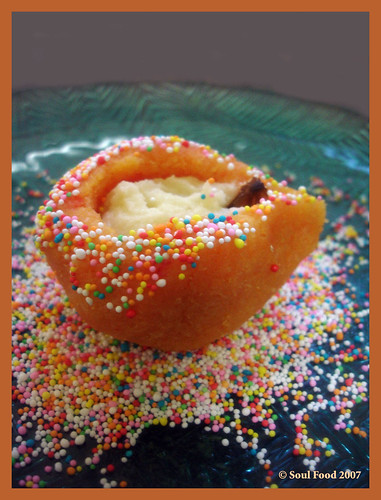
When I saw the recipe for these edible coconut diyas, I fell in love with them and promised to make them on diwali….here is the recipe. I used orange food colour to give them that earthen clay hue.

The recipe doesn’t fill the diyas with anything, so I put in a small dollop of soft sweet khoya as symbolic ghee with a sliver of almond for the wick.

I also decorated them with ‘hundreds and thousands’ - tiny coloured sugar balls. I tried decorating them with silver vark, but it got messy....


So here's wishing all my readers all the happiness in the world.... my advise is ....make lots of sweets, share them with all your family and friends, eat them too and have a joyous time!
This is going to Vee of Past Present and Me for the wonderful event JFI special series: The festive series...

This is also going to Meeta's Monthly Mingle for Traditional Feasts.

Tuesday, October 30, 2007

Karva chauth di sargi: Early morning vermicelli pudding

I love fasting on karva chauth despite it being a grueling day of controlling your hunger and thirst, and not because it’s the most fanciest custom that bollywood has to show in their movies nowadays. But fasting like this is when one gets to really appreciate the food we eat and the water we drink daily.

Mostly I feel more thirsty than hungry. But somehow it feels good to fast on the day. Its not just 'fast for your husband's long life' as is mostly portrayed, its also about celebrating your wedded life and marriage.

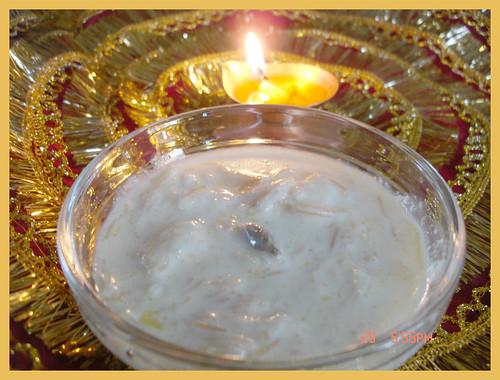
The day started for me at 3:30am, when I got up to eat my sargi and to drink all the water I could before sunrise. ‘Sargi’ is just the (punjabi) name given to the delicious vermicelli kheer (see recipe below) eaten in the morning.

According to traditional custom, a married woman takes the 'sargi', which is prepared specially for the ocassion by the mother-in-law, and leaves on the previous day to go to her mother’s house. In the wee hours of the morning she eats it with her mother and other aunts that have gathered there. The fast begins at twilight, and women fast from food and water.

When the day starts, the women folk spend decorating themselves with henna and getting dressed up in their wedding apparels, and pretty much look like brides. In today’s times they go shopping, they especially buy decorated bangles and sometimes spend the afternoon at the movies!
Around late afternoon, ranging between 3pm to 6pm (depends on the individual family custom), the daughter-in-law arrives with her mother and her aunts at her in-laws place. Here all the ladies, including that of the neighbourhood gather to perform the ‘poiya mansna’ ceremony. They get into a circle and rotate their pooja thalis whilst singing traditional songs.
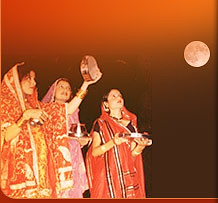
Ive always heard the one that Ive shown below, “kudiye karwada....”. Here in Africa, we gather mostly at the local temple hall and do this ceremony. Then one of the elder lady tells us the ‘katha’, the story behind the fast. The hardcore ‘pindi’ punjabi (village accent) becomes a foreign language to me and I’m lost after a few lines into the story!

I just enjoy the whole ceremony of seeing so many women all dressed up. Its like seeing all your friends, aunts, and all women as brides all on the same day! We admire each other’s jewellery, mehndi and wedding gowns etc. :D

A lot of woman take their first sip of water after this ceremony, and have some form of liquid to relieve themselves. They have food only after the moon comes out. Some (really dedicated wives) wait with thirsty throats up until the time the moon comes out.

I had a big glass of water at 4:30 pm and then another glass of juice. From then the wait starts…for the moon to come out. In India, I have heard from my mum that the moon comes out around 8:00pm. Then all the women rush outside and offer obeisances to the moon and see the moon through a seive (I have no idea, why all this is done so). Thereafter they break their fasts.

And because some of us are in the southern hemisphere… we waited till 10:30pm and there was no sign of the moon… After another gruelling, half an hour…the moon was sighted at 11:00pm and we finally broke our fasts and had food. By then I wasn’t even hungry, but nevertheless ate to replenish the energy I had lost! My malayalee husband still doesn’t get why I need to do all this… I know I do it for the fun of it!

"Karva Chauth Day falls on the 4th day of the Kartik month every year. On this day it is customary for the wife to fast the whole day. She does not drink water either. She paints her hands and feet with henna, dresses generally in red apparel ...

On Karva Chauth day, which is observed in North India, tens of millions of women keep a fast, .... Only after seeing the moon do the women break their day-long fast in the evening/night. Normally women go out of their houses and on their roof tops to see if the moon is up yet.

Here is the song sung by punjabi women, while they exchange thalis seven times.

Veero Kudiye Karwada...., Sarv Suhagan Karwada...,
Aye Katti Naya Teri Naa, Kumbh Chrakhra Feri Naa,
Aar Pair payeen Naa, Ruthda maniyen Naa, Suthra Jagayeen Naa,
Ve Veero Kuriye Karwara,Ve Sarv Suhagan Karwara....... "

picture and text:http://www.karwachauth.com

Karva chauth ki sargi

What you need:

- 250 gm wheat vermicelli
- 50 gm ghee (can completely zero the ghee, if you want to make it fat free)
- 1 Lt full cream milk (can easily use 2% reduced or even skim milk to make it ‘lighter’)
- 200 gms sugar (again, this amount gives the kheer a mild sweetness, up or own the amount to suit your palate). Here sugar can also be substituted for brown sugar or jaggery for more flavour.
- A few pods whole elaichi
- Saffron strands
- Chopped nuts of your choice ( I did not put any in this version)

What you need to do:

1.) In a large pot roast the vermicelli in the ghee. The vermicelli can be dry roasted too (without any ghee for a low fat version). Stir frequently to allow equal roasting.

2.) Add the milk and elaichi pods and bring to the boil. When boiling, reduce gas to a simmer and cook for a further 10-12 minutes. The vermicelli will swell in size and soak up the milk.

3.) Switch off the gas and decorate with saffron and nuts. The kheer (pudding) can be had warm and or can be cooled down and refridgerated and served chilled.

We (mum and I) had it cold in the morning, drank lotsa water and went back to sleep!
This is going to Vee of Past Present and Me for the wonderful event JFI special series: The festive series...

Friday, October 19, 2007

Peanut ladoos for navratri, contribute for Feed-a-hungry-child and a meme

These ladoos are so easy and are great for kids to learn and make.
But first I want to put in a plea to keep contributing to ‘feed a hungry child’ as there are still a few days left for the fund raising drive. Even though the fund-drive goal of raising 3, 360 dollars has been crossed, we can contribute more to feed more mouths.

(FHC): feedahungrychild.org is a not-for-profit charitable organization formed in a collaborative effort of the like-minded people from all around the world. It aims to replace the empty plates of the underprivileged children and replace them with ones of food. While FAHC addresses the holistic needs of each children it supports, it believes illiteracy, malnutrition, and other concerns can only be addressed when hunger is appeased.
Join the fight against global poverty…. Help feed children one by one…

Please chip-in and contribute here, or here or go to the FHC website...

And now onto the easy-peasy laddoo recipe:

What you need:

- 350 gm peanut butter (crunchy – if you want bits of nut, smooth – if you want a smooth texture)
- 250 gm khoya (make a semi-hard dough with full cream milk powder and milk and microwave it for 10 minutes on low, cool and grate finely)
- 200gm brown icing sugar (can use normal icing sugar too, and reduce the amount if you find it too sweet)
- 1 tsp elaichi (cardamom) powder
(This amount made 50 ladoos of 2.5 cm diameter (average size for a ladoo) )

What you need to do:
1.) Combine all the ingredients in a large bowl thoroughly. Shape into round ladoos.

Tips:
-Use splashes of milk to moisten a dry mixture, that is becoming to difficult to combine.
- If the mixture is too wet and gooey (which it will hardly be), you can use dry dessicated coconut to make the mixture pliable.

Verdict: These ladoos look and taste exactly like besan (gram flour) laddoos in texture and 90% in taste, so they are great for when fasting from grains. You just get a peanutty taste instead. Also, there is no ‘extra’ ghee I added this time and they tasted great; the only fat comes from the peanut butter. Plus, I looooved making them because of how easy they were to make. They are really good for kids to make too.

See how I made them last year for Navratri, the recipe is pretty much the same, except I didn’t put ghee this time.

This is going to Vee of Past Present and Me for the wonderful event JFI special series: The festive series...
This is also going to Viji of Vcuisine for the wonderful event RCI Tamil Festive Series...

Now for my first meme that Sweet Sig tagged me for:

4 Places I’ve lived:

- Kisumu, Kenya
- New Delhi, India
- Selebi- Phikwe, Botswana
- Gaborone, Botswana

4 Jobs I’ve had / (wish I could have)

- Computer Technician Attachee / Interior Decorator
- Systems Analyst Junior / Coolest restaurant-in-town owner and chef
- Assistant Computer Lecturer (in parallel with 2) / Flower Bouquet Designer(I’m gonna do this when I’m old and grey anyway)
- Computer Engineer / Pencil, Pastel and Oil Painter

4 Favorite places I’ve holidayed:

1. Venice – I was in awe of all the canals dotted with the beautiful houses, the islands and the awesome Italian food. And people, Venice is sinking… hope the engineers can save it in the nick of time.
2. Vienna – Oh this city is truly musical, the opera we went to was to-die-for… and they played all the famous classical numbers especially my fav ..Mozart… there was even a Pavarotti look a like with a ballerina…sigh….
3. Cape Town – was amazing… with all the history and unique flora and fauna, vineyards and wine….Robin island where Mandela spent 26 (?) years.
4. Pongundam near Kottayam – This is a huge rubber plantation… my sin-in-law’s in-law’s place. It was breath-taking and beautiful. And my SIL’s MIL made such yummy food for us…

4 Favorite foods

1. Homemade corn pizza (with bits of paneer)
2. Pasta Recco – at our fav Italian restaurant, I don’t even bother looking at their menu…
3. Chilli Gobhi Dry - Also at out fav south Indian restaurant…. I’m trying really hard (with the help of my mum) to recreate this dish at home… and when I told this to a fellow blogger friend, she loved it too… will post it soon
4. Tie between Appam-stew and Onam sadya(incl parip payasam) – Coz after consuming both relishes, it induces a zombie reaction in the body, where we drift towards the next closest place to lie down and drift into slumber land.

4 Places I’d rather be

- On a looooong drive with M (hubby) where we talk and talk and talk.
- Playing with my son, and going to see the bho-bhos (dogs)
- Touring the world
- Doing something creatively fun (painting, cooking, crafty things).

4 bloggers I like to tag

Wanted to tag Musy, and Lakshmi(Yum), but they’ve already done this meme…


Please take it up only if you wish to...

Monday, September 3, 2007

Sweet Pedas for Sweet Krishna

Shri Krishna Janamashtami also known as Krishna Jayanti, Shri Jayanti and Gokulashtami amongst many names. It is the most revered festival in our house.

Janmashtami, (as it is casually known) is one of the most popular festivals of Hindus which celebrates the birth of their beloved God, Sri Krishna. Detailed story of Janmashtami or Lord Krishna's birth has been narrated in Puranas. Please read here for details.

Sri Krishna was born in the month of Sravana more than 5000 years ago. According to some scholars, Krishna was born on Wednesday, the eighth day (Ashtami) of the second fortnight in Sravana month in the year of Visvavasu around 3227 BC, also known as Dwapur Yug. He lived for 125 years and his departure was the onset of the current corrupt age known as Kaliyug (that we are in right now). Source: here

Shri Krishna has uncountable names and forms that devotees pray to. In Kerala Krishna is prayed in the form of Guruwayurappan.

The word Guruvayurappan, meaning Lord of Guruvayur, comes from the words Guru referring to Brihaspati, the Guru of the Devas, Vayu, the God of Wind and Appan, meaning father or Lord in Malayalam. Since Guru (Brahaspati) and Vayu Deva is said to have installed Lord Krishna's statue, the name Guruvayurappan was given to the lord. Although many temples of Guruvayurappan exist, the oldest and most famous of them all is located in the town of Guruvayur, Kerala, India.

Guruwayoorappan pic source
Lord Krishna at Guruvayur, a city located in Trichur district in Kerala, India, is worshipped as Lord Guruvayurappan. It is believed that the idol of Lord Guruvayurappan was worshipped by Vasudeva, father of Lord Krishna and represents the full manifestation of Lord Maha Vishnu. The idol is made of a stone called "Patala Anjanam" or black bismuth and is in the standing pose with 4 arms carrying the shanku (conch), the chakra (discus), the gada (mace) and padma (lotus). Guruvayur is also hailed as "Bhooloka Sri Vaikuntham" where the Lord reveals himself to his devotees in the same majestic form in which he welcomes them in Vaikuntha, his celestial abode. Source: Wikipedia
See the beatiful oil lamps that are lit around the temple ay Guruwayoor here

Since Krishna loves sweets things made of milk and milk products, so a post on his favourite ‘pedas’ was inevitable on Soul Food. This is also a very easy recipe, as its made in the microwave. This Krishna prashad is a regular at Ramayan poojas and Janamashtami at our house.

What you need:

- 4 cups full cream milk powder
- 1 cup sugar
- 2 cups milk (full cream)
- 2 tsp elaichi (cardamom) powder
- a few tsp ghee to combine the pedas

What you need to do:

1. Dissolve the sugar and elaichi powder in the milk to make a syrup. Microwave it until the sugar dissolves.

2. Use the syrup to combine the milk powder to make a very soft dough. Microwave on high for 5 minutes. Use a knife and spoon to cut into the dough to see if it has changed colour. It should slightly darken( go from cream colour to light caramel). The mixture will also get drier as you go along.

3. Microwave for another 4 minutes and check again, if the dough has cooked or not. If it has not, microwave it further in 2 rounds of 2 minutes, checking to see if the peda mixture is cooked. At the end of these rounds, it would definitely have been cooked through.

4. Let it cool until it is warm enough to handle by hand. Grate it finely with a grater. Use ghee in your hands and shape into pedas and keep for bhog. If the mixture is too wet, dry dessicated coconut can be added to firm them up. If the mixture is too dry, you can add splashes of milk to soften the mixture.

The pedas can be decorated with silver vark. Put pedas for bhog on Krishna Janmashtami and then feast on them later! This makes about 25 – 30 pedas.

1. This is going to Latha of The 'yum' blog for her lovely festival series: Janamashtami.

2. This is also going to Srivalli of Cooking for all seasons: as a gracious late entry for her lovely microwave event.

Saturday, August 4, 2007

Express Sukhi dal with phulka and salad


How many times do we want a quick meal because we are so hungry, or because we are out of time? A lot of times I have a hungry hubby calling me that he's on his way home and ravenous. Amd most times no take away order satisfies the belly like a yummy homemade meal.

The express event in which we need to cook a full nutritious meal within 30 minutes conceived by mallugirl of Malabar Spices is a superb idea. I told her it would be a great resource; to pool in express ideas that'll come to our rescue when we are in such an edaciously vulnerble state!

I love this sukhi dal, even if its made in 45 minutes too! Its that yummy. You can use urad split as opposed to moong that I've used here. This dal is also used to stuff samosas and its equally yummy with any roti or phulka.

Timing myself and serving a meal for two, here goes:

What I need:
- dough for roti (am not counting dough making for the roti, alhough I know some superwomen who can squeeze that in too!): combine warm water with brown bread flour (atta) to make a soft dough. This dough can be refridgerated for later use too, like i am using dough from the fridge here.
- 2 cups moong split (yellow moong dal without skin - moong dhuli)
- 8-10 shallots (can use 2 large size onions and a tsp of sugar when sauteeing them)
- 2-3 tsp ghee/oil (any vegetable oil) for the tempering
- 2 tsp jeera (cumin seeds)
- 3 tsp ginger powder (saunth)
- 2 tsp dry dhania powder (coriander seeds powder)
- a pinch of garam masala
- a handful of freshly chopped dhania (green coriander leaves)
- 1/2 tsp haldi (tumeric)
- salt to taste
- lemon juice (from about 1 lemon)
- optional salad ingredients (such as a cucumber, half a head of lettuce, a tomato, and a small green pepper)
- green chillies (optional)

What you need to do (timed):

(0 - 5 min)
1. Wash the dal in three rounds of water. Put the dal with double the amount of water (for this recipe 4 cups), haldi and salt on a high flame. Peel the required number of leaves from the lettuce head, wash them under running water and leave them to drip (I hate watery salad leaves). Peel the shallots, and gather your spices.

(5 - 10 mins)
2. Chop the shallots (not too finely, about 3/4cm cubes) and give the dal a stir. On another burner, put a kadai(wok) on medium flame, and put in the ghee, when the ghee becomes hot (takes a few seconds). Add the jeera seeds and saute briefly, when the jeera changes a few shades darker add the ginger powder and shallots and saute.

Chop the green coriander leaves and keep aside. When my chopping board is empty of the onions and the coriander leaves I start chopping whatever I can fathom and combine as a salad from the fridge. Chop an english cucumber into half and then into slices in between stirring the dal and swaying the onions. The dal should be coming to a boil by now.

(10 - 15 mins)
3. After chopping/slicing the cucumber, start chopping the green pepper (keep emptying your chopping board into a bowl). When the dal come to a strong (rolling) boil, cover the pan and reduce the gas to a medium low. Chop a tomato and throw that into the salad bowl tool.

Keep moving the onions, we need to caramalize them, not saute them to a mash. They should retain a crunchyness. Add the dhania powder, and garam masala to the onions and stir. Give the dal a stir after 3-4 minutes.

(15 - 20 mins)
4. Take the onions off from the flame, let cool and put the tava(flat griddle) on the stove. Make enough balls from the dough for the number of phulkas u need. Roll each dough into a 15cm round and put on the tava. When it changes colour (thats maybe 30 sec) turn and cook the other side for about a minute (in between you should be rolling another dough ball). Throw the phulka on an open flame (and simultaneously the next rolled dough circle onto the tava), keep turning the phulka on the open flame until it rises to the fullest. Take it off from the flame (optionally dab the phulka with a tiny bit of ghee) and pile it up in a roti box. Keep the phulka process going and check and stir the dal, if the dal seems too dry, add another 1/2 cup of water. Cover and let it simmer further.

(20 - 25 mins)
5. Keep working on the phulkas. I made 6 phulkas for a hungry husband and a hungry me. If you are done with the phulkas, tear up the salad leaves into bite size. Now if the salad is too naked for you, you might as well dress it the way you want. Sometimes we just sprinkle salt and pepper on it; and other times I shake some salt, black pepper, lime juice and a tsp of olive oil in a small bottle and dribble over it, its your choice really. Stir the dal and check if the dal is cooked (slighltly cool a few granules of the dal and press between two fingers). We want the dal to be cooked thouroughly just before it reaches the state where it can be mashed up, dal al dente?!

(25 - 30 mins)
6. Cook the dal for another couple of minutes if needed. Sprinkle the sauted onions, chopped coriander leaves and lemon juice onto the dal and combine. Serve the dal with a phulka and a big serving of salad into two plates. And then dig in this healthy quick meal offcourse!